Introduction to EN124 Manhole Cover Load Ratings
When specifying access covers for infrastructure projects, understanding the manhole cover load rating EN124 classification system is essential for ensuring safety, compliance, and long-term performance. The EN124 standard, formally known as EN 124-1:2015, defines six load classes — A15, B125, C250, D400, E600, and F900 — that specify the maximum load a manhole cover can safely support. Whether you are specifying covers for a pedestrian walkway, a residential driveway, or a Category I airport runway, the correct EN124 load rating determines not only safety but also the material selection and installation method.
This comprehensive guide covers everything from the history of the EN124 standard to a complete classification table, testing methods, material performance across ratings, and comparisons with global standards such as AASHTO (USA) and AS3996 (Australia). By the end, you will know exactly how to select the right manhole cover load rating EN124 for your specific application.
What Is the EN124 Standard and Its History?
The EN124 standard originated in 1994 as a European harmonized standard for gully tops and manhole tops used in vehicular and pedestrian areas. It replaced dozens of fragmented national standards across Europe, including the British BS 497, the German DIN 1229, and the French NF P98-311. The current version, EN 124-1:2015, is maintained by the European Committee for Standardization (CEN) and is recognized across all EU member states plus many other countries worldwide.
The standard specifies requirements for the design, testing, marking, and quality control of manhole covers and gully gratings. Its primary purpose is to ensure that covers installed in different traffic zones can withstand the expected loads without failure. The manhole cover load rating EN124 system classifies covers into six groups based on the minimum test load they must withstand, ranging from 15 kN (approximately 1.5 tonnes) for A15 to 900 kN (approximately 90 tonnes) for F900.
Since its introduction, EN124 has been widely adopted outside Europe as a de facto international standard for specifying manhole cover load ratings. Many countries in the Middle East, Asia, and Africa reference EN124 in their national building codes, making it the most globally recognized standard for access cover load classification.
Complete EN124 Load Rating Classification Table (A15 to F900)
The table below summarizes all six EN124 load classes, their test loads, equivalent tonnage, typical applications, and common materials used.
| Class | Test Load | Equivalent Weight | Typical Application | Common Materials |
|---|---|---|---|---|
| A15 | 15 kN | 1.5 tonnes | Pedestrian areas, gardens, cycle paths | FRP/composite, plastic |
| B125 | 125 kN | 12.5 tonnes | Footways, car parks, driveways | FRP/composite, ductile iron |
| C250 | 250 kN | 25 tonnes | Side roads, slow lanes, roundabouts | Ductile iron, FRP/composite |
| D400 | 400 kN | 40 tonnes | Highways, main roads, heavy traffic lanes | Ductile iron, cast iron, FRP |
| E600 | 600 kN | 60 tonnes | Industrial zones, docks, loading areas | Ductile iron, steel |
| F900 | 900 kN | 90 tonnes | Airports, military sites, ports | Ductile iron, reinforced steel |
Each class is defined by the manhole cover EN124 load rating test load in kilonewtons (kN). The cover must withstand this load without cracking, permanent deformation exceeding 1/300 of the clear span, or any loss of function. The classification applies to both manhole covers and gully gratings, and the same testing protocol is used across all six classes.
Detailed Guide: A15 — Pedestrian and Garden Areas
The manhole cover EN124 load rating A15 is the lightest classification in the EN124 standard. Covers with an A15 rating must withstand a minimum test load of 15 kN, equivalent to approximately 1.5 tonnes. These covers are intended exclusively for areas used by pedestrians and cyclists, with no vehicular traffic.
Where are A15 rated manhole covers typically used? A15 covers are most commonly installed in pedestrian walkways, parks, gardens, cycle paths, and residential lawns. They are also suitable for light-use areas such as landscaped zones, public squares, and footpaths where the risk of vehicle loading is negligible.
How much weight can an A15 manhole cover support? An A15 cover supports up to 1.5 tonnes (15 kN) under test conditions. In practice, the working load limit is lower to provide a safety margin, making A15 covers ideal for foot traffic only. They should never be installed in areas where vehicles may drive or park.
Are A15 manhole covers suitable for pedestrian areas? Yes, A15 is specifically designed for pedestrian-only zones. Combined with their lightweight construction, A15 covers are often made from FRP (fiber-reinforced polymer) or composite materials, making them easy to handle and install. They are also corrosion-resistant and theft-resistant.
Can I use an A15 rated cover in a garden or lawn? Absolutely. A15 covers are a popular choice for garden and lawn applications because they are lightweight, easy to cut to size, and do not rust. FRP composite A15 covers are particularly favored for residential landscaping.
What is the difference between A15 and B125 EN124 ratings? The key difference is load capacity: A15 supports 1.5 tonnes (pedestrian only), while B125 supports 12.5 tonnes and can handle passenger vehicles. B125 is required for any area accessible to cars, even occasionally.
Detailed Guide: B125 — Footways and Car Parks
The manhole cover EN124 load rating B125 classification covers the next tier up from A15, with a test load requirement of 125 kN (approximately 12.5 tonnes). B125 is the minimum rating required for any area accessible to passenger vehicles.
Where are B125 manhole covers typically installed? B125 covers are used in footways (sidewalks), pedestrian precincts, car parks, residential driveways, and slow-traffic areas. Municipal authorities often specify B125 for pavement access covers where occasional overrun by cars is possible but heavy trucks are excluded.
How much weight can a B125 rated manhole cover support? A B125 cover supports up to 12.5 tonnes under test conditions. This is sufficient for passenger cars, SUVs, and light vans. However, B125 covers should not be installed where delivery trucks, refuse vehicles, or heavy commercial traffic may pass.
What is the test load for a B125 EN124 manhole cover? The official test load is 125 kN, applied through a rigid steel pad measuring 250 mm × 250 mm or a circular pad of equivalent area. The cover must show no crack, no permanent deformation exceeding the standard limit, and no loss of function after the test.
B125 vs C250 manhole cover: which load rating do I need? If only cars and light vehicles access the area, B125 is sufficient and more economical. If occasional light trucks or service vehicles may cross, upgrade to C250 (25 tonnes) for an extra safety margin. For residential driveways where only private cars park, B125 is usually adequate.
Are B125 manhole covers suitable for car parks? Yes, B125 is the standard specification for multi-story car parks, surface parking lots, and residential parking areas. However, for car park entrances where delivery trucks may turn, C250 or D400 is recommended.
B125 covers are commonly manufactured in ductile iron (Grade 500-7) and increasingly in high-strength FRP composite materials, which offer excellent corrosion resistance and lighter weight for easier installation.
Detailed Guide: C250 — Side Roads and Slow Lanes
The manhole cover EN124 load rating C250 is a mid-range classification requiring a test load of 250 kN, equivalent to approximately 25 tonnes. C250 covers are designed for areas with slow-moving vehicular traffic and occasional light truck access.
Where are C250 rated manhole covers typically used? C250 covers are installed in side roads, cycle lanes (adjacent to roads), residential streets, car park access routes, service roads, and petrol station forecourts. They are also commonly specified for roundabouts and traffic-calmed zones where vehicles move slowly.
How much weight can a C250 manhole cover support? A C250 cover supports up to 25 tonnes under test, which covers cars, light commercial vehicles, and small delivery trucks. While sufficient for many municipal applications, C250 is not rated for heavy goods vehicles (HGVs) or continuous heavy traffic.
What is the test load for a C250 EN124 manhole cover? The test load is 250 kN, applied following the same protocol as lower classes. The cover must remain crack-free with no permanent deformation greater than the specified limits. C250 covers are subject to rigorous quality control testing during production.
C250 vs D400 manhole cover: which load rating is right for me? For residential streets and light-traffic roads, C250 is typically sufficient. For main roads, highways, or bus routes, D400 is mandatory. The key decision factor is whether heavy trucks or buses will regularly use the road — if yes, choose D400. If only cars and light vans, C250 is appropriate.
Are C250 manhole covers suitable for car parks and side roads? Yes, C250 is the recommended minimum for car park access routes and side roads that see occasional delivery vehicle traffic. Many municipalities specify C250 for all in-road applications outside main traffic arteries.
C250 covers are widely available in ductile iron and FRP composite materials. FRP C250 covers offer the advantage of being lightweight (typically 60-70% lighter than cast iron equivalents) while still meeting the 250 kN test load requirement. They are also corrosion-proof, making them ideal for environments where road salts or chemicals are present.
Detailed Guide: D400 — Highways and Main Roads
The manhole cover EN124 load rating D400 is the most widely specified classification for road applications. With a test load of 400 kN (approximately 40 tonnes), D400 covers are designed for highways, main roads, and all areas with regular heavy traffic.
Where are D400 rated manhole covers required by regulation? D400 is the minimum classification for carriageways of roads, highways, and motorways where heavy vehicles travel at speed. It is also required for hard shoulders, bus lanes, and any road surface subject to regular HGV traffic. Municipal road authorities across Europe mandate D400 for all in-road access covers on public highways.
How much weight can a D400 manhole cover support? A D400 cover supports up to 40 tonnes under test, which accommodates heavy goods vehicles, buses, emergency vehicles, and construction equipment. The working load is typically derated to 70-80% of the test load to provide an adequate safety factor in service.
What is the test load required for D400 EN124 certification? The official test load is 400 kN, applied using the EN124-1:2015 testing protocol. The cover is placed on a rigid test frame simulating its installed condition, and the load is applied incrementally through a steel pad of specified dimensions. The cover must not crack, must not exhibit permanent deformation exceeding 1/300 of the clear span, and must maintain full function — including the locking mechanism.
D400 vs E600 manhole cover: which load rating do I need? For standard public roads and highways, D400 is the correct choice. E600 is reserved for heavy industrial zones, container terminals, and loading areas where forklifts and heavy plant equipment operate. If your application is a public road with normal HGV traffic, D400 is sufficient. For docks, logistics centers, or industrial estates, consider E600.
Are D400 manhole covers suitable for highways and main roads? Absolutely. D400 is the industry standard for highways, main arterial roads, and any carriageway subject to general traffic. It is the most common specification for road authorities worldwide.
D400 covers are traditionally manufactured in ductile iron (spheroidal graphite iron) per EN 1563. However, advanced FRP composite D400 covers have gained significant market share in recent years. Modern SMC (sheet molding compound) FRP D400 covers meet the full 400 kN load requirement while weighing 60-70% less than cast iron, eliminating the need for heavy lifting equipment during installation.
Detailed Guide: E600 — Heavy Industrial and Dock Areas
The manhole cover EN124 load rating E600 is a heavy-duty classification requiring a test load of 600 kN, approximately 60 tonnes. E600 covers are designed for the most demanding industrial environments.
Where are E600 rated manhole covers typically installed? E600 covers are used in heavy industrial zones, warehouse loading bays, container terminals, dockyards, logistics parks, and areas with frequent forklift and heavy plant vehicle traffic. They are also specified for bus depots, fire station driveways, and emergency vehicle access routes where axle loads are exceptionally high.
How much weight can an E600 manhole cover support? An E600 cover supports up to 60 tonnes under test, covering the heaviest industrial vehicles including loaded container trucks, heavy forklifts (10-20 tonne capacity), and mobile cranes. The actual in-service load capacity includes a generous safety margin below the test load.
What is the test load for E600 EN124 classification? The test load is 600 kN, applied following the same standardized EN124-1:2015 procedure. Due to the extreme loads, E600 covers are typically made from higher-strength materials such as ductile iron Grade 600 or reinforced steel. Some advanced FRP composite covers have also been developed to meet E600 requirements.
Are E600 manhole covers required for airport runways? No, airport runways and taxiways require F900 (900 kN), the highest EN124 classification. E600 may be suitable for airport service roads, cargo handling areas, and maintenance aprons, but the runway itself demands F900.
E600 vs F900 manhole cover: which is for heavy industrial use? For most heavy industrial applications — docks, warehouses, loading areas — E600 is sufficient. F900 is reserved for exceptional loads such as aircraft, military vehicles, and port container stackers. If your site sees aircraft traffic or extreme point loads, choose F900.
Detailed Guide: F900 — Airports and Military Installations
The manhole cover EN124 load rating F900 is the highest classification in the EN124 standard, with a test load of 900 kN — equivalent to approximately 90 tonnes. F900 covers are engineered for the most extreme loading environments.
Where are F900 manhole covers typically required? F900 covers are mandatory for aircraft runways, taxiways, and aprons at commercial and military airports. They are also required at military installations, container ports, dockyards, and heavy industrial sites where massive point loads from aircraft, tanks, container stackers, or heavy transport equipment are expected.
How much weight can an F900 manhole cover support? An F900 cover supports up to 90 tonnes under test conditions. This accommodates the highest axle loads in civil engineering, including fully loaded aircraft (such as a Boeing 747 main landing gear load), heavy military vehicles, and port container gantries.
What is the test load for F900 EN124 classification? The test load is 900 kN, following the same standardized testing procedures as lower classes but with the highest load specification. F900 covers must be manufactured from the strongest materials available — typically ductile iron Grade 700, reinforced steel, or specialized high-strength composites with additional reinforcement.
Are F900 manhole covers required for airport runways and military sites? Yes. International civil aviation authorities (ICAO, FAA) require F900-rated covers for runway and taxiway surfaces. Lower ratings such as E600 may be used for airport service roads and cargo areas, but the runway itself demands F900. Military sites with heavy vehicle traffic also mandate F900.
F900 vs E600 manhole cover: which is for port and dock areas? For standard quayside and container terminal areas, E600 is usually sufficient for most applications. However, F900 is specified for areas directly under container stackers, ship-to-shore cranes, and heavy lift zones where point loads can exceed 60 tonnes. Always consult a structural engineer to determine the correct rating for port applications.
Due to the extreme loads, F900 covers are significantly heavier than lower-rated covers. A typical F900 ductile iron cover can weigh 200-400 kg depending on size, requiring mechanical lifting equipment for installation. FRP composite alternatives are being developed to reduce weight while maintaining the 900 kN rating.
EN124 Testing Methods: How Load Ratings Are Verified
Each manhole cover load rating EN124 class is verified through a precise, standardized testing protocol defined in EN 124-1:2015. Understanding these testing methods is essential for manufacturers, specifiers, and quality assurance professionals.
Test Setup and Procedure
The test is performed using a calibrated hydraulic or screw-type testing machine. The cover is placed on a rigid support frame that simulates its actual installed condition, with the frame dimensions matching the clear opening of the cover. The load is applied through a rigid steel pad measuring 250 mm × 250 mm for square covers, or a circular pad with equivalent area for round covers. The pad is centered on the cover surface to create the most severe loading condition.
Load Application
The test load is applied gradually and uniformly, increasing at a controlled rate not exceeding 10 kN per second. Once the full test load is reached, it is maintained for a minimum of 30 seconds. For example, a D400 cover (400 kN test load) must hold this load for 30 seconds without failure. The cover must not exhibit any cracks, fractures, or permanent deformation exceeding 1/300 of the clear span dimension.
Acceptance Criteria
- No crack or fracture under the full test load
- Permanent deformation after load removal must not exceed 1/300 of the clear span
- Functionality preserved — the cover must still open, close, and lock correctly
- Markings remain legible after testing
Type Testing vs. Production Testing
Initial type testing is performed when a new design is introduced. Production testing is conducted periodically (typically every 500-1000 units) to verify ongoing quality. For FRP composite covers, additional testing for UV resistance, chemical resistance, and low-temperature impact may also be required depending on the application environment.
Manhole Cover Materials and EN124 Performance
The choice of material significantly affects how a cover performs at each manhole cover load rating EN124 class. Here is a breakdown of how the four most common materials perform across the EN124 rating spectrum.
FRP (Fiber-Reinforced Polymer) / Composite Covers
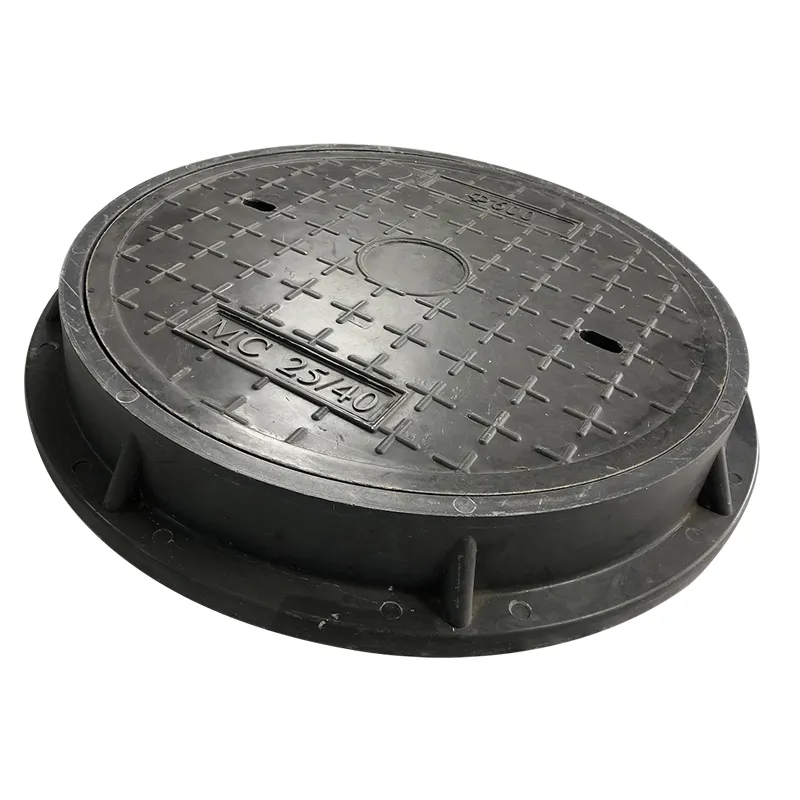
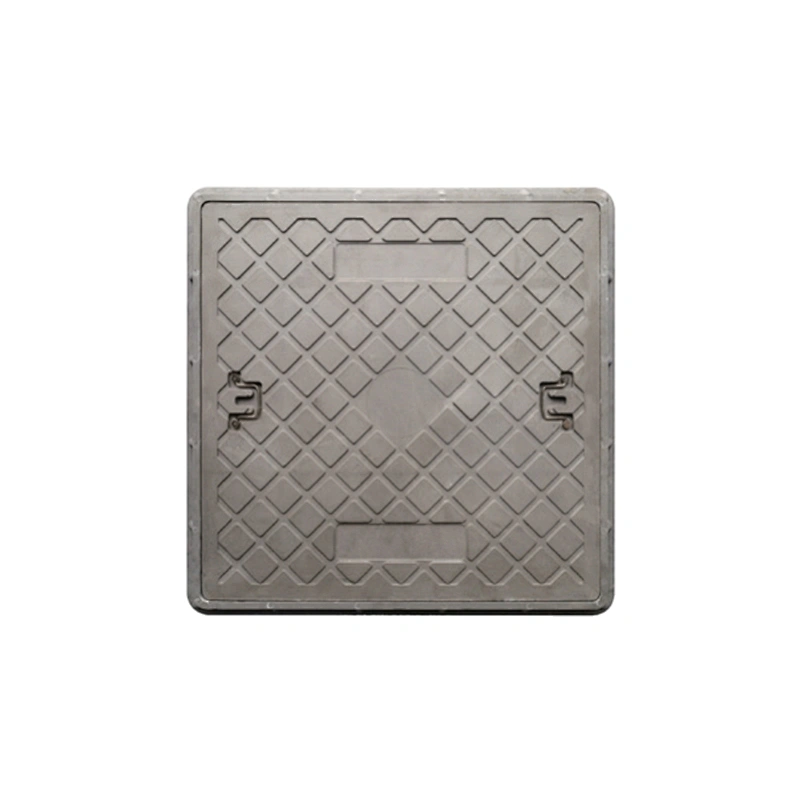
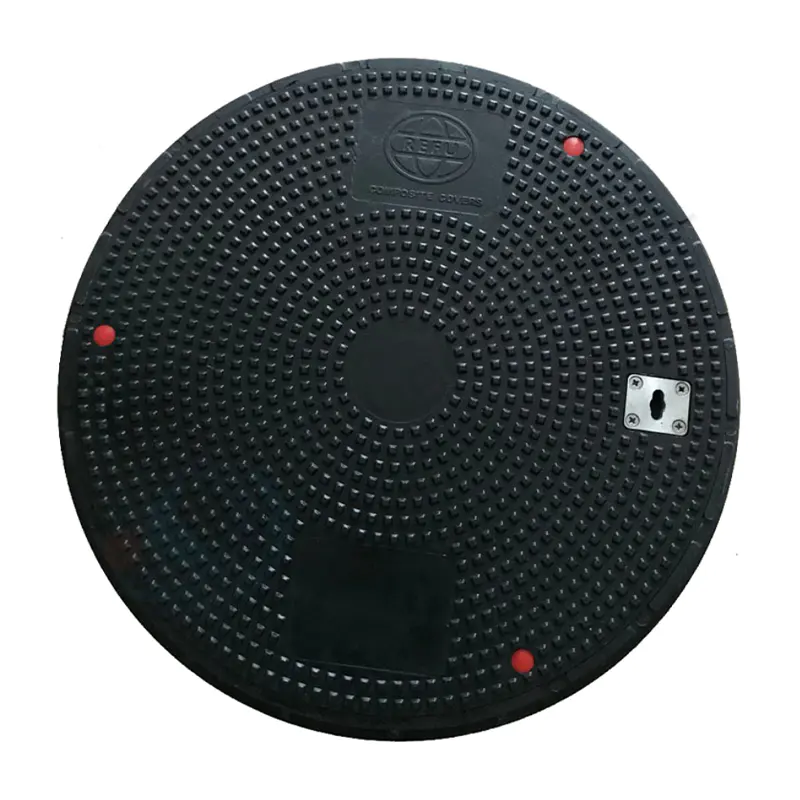
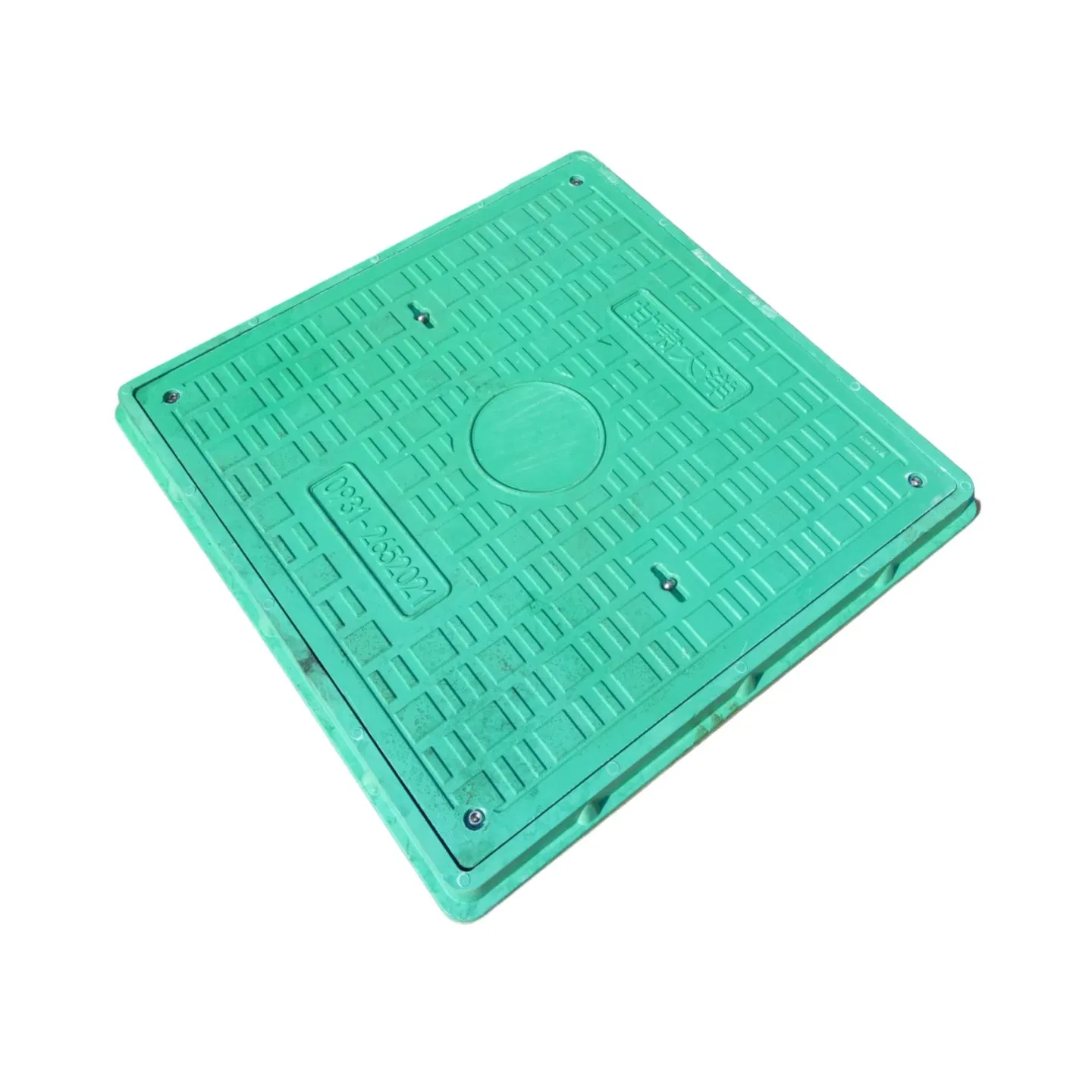
FRP manhole covers, also known as composite or SMC (sheet molding compound) covers, are made from glass fiber reinforced thermosetting resin. They are available from A15 through D400, and in some advanced formulations up to E600. Key advantages include:
- Lightweight — 60-70% lighter than cast iron equivalents, reducing installation costs and injury risk
- Corrosion-resistant — impervious to road salts, chemicals, seawater, and sewage gases
- Theft-resistant — no scrap metal value, eliminating theft problems common with cast iron
- Non-conductive — electrical safety in utility access applications
- Customizable color — can be molded in RAL colors for aesthetic integration
FRP covers perform exceptionally well at A15 and B125 classes and are increasingly popular at C250 and D400. The main limitation is that FRP is not yet widely available at E600 and F900 ratings, though technology is advancing rapidly.
Cast Iron (Gray Iron)
Traditional gray cast iron (EN 1561) has been used for manhole covers for centuries. It offers good compressive strength but is brittle in tension. Cast iron covers are typically limited to A15 through C250 ratings due to their tendency to crack under impact loads. They are heavy, prone to corrosion, and have high scrap value making them theft targets.
Ductile Iron (Spheroidal Graphite Iron)
Ductile iron (EN 1563, Grade 500-7 or 600-3) is the premium material for high-load manhole covers. It offers high tensile strength, excellent impact resistance, and ductility that prevents brittle fracture. Ductile iron is the standard material for D400, E600, and F900 classes. Its main drawbacks are high weight and susceptibility to corrosion if the protective coating is damaged.
Material Comparison Summary
| Material | A15 | B125 | C250 | D400 | E600 | F900 | Weight vs Iron |
|---|---|---|---|---|---|---|---|
| FRP/Composite | ✅ | ✅ | ✅ | ✅ | ⚠ Limited | ❌ | 60-70% lighter |
| Cast Iron | ✅ | ✅ | ✅ | ⚠ Rare | ❌ | ❌ | Baseline |
| Ductile Iron | ✅ | ✅ | ✅ | ✅ | ✅ | ✅ | Similar |
Comparing EN124 with Global Standards: AASHTO and AS3996
While EN124 is the dominant global standard for manhole cover load ratings, other regions have their own classification systems. Understanding the equivalencies is critical for international projects. Here is how EN124 compares with the US AASHTO standard and the Australian AS3996 standard.
EN124 vs AASHTO (USA)
In the United States, manhole cover load ratings are typically specified according to AASHTO M306 (Standard Specification for Manhole Frames and Covers) or ASTM C478. Unlike EN124's numerical rating system, AASHTO uses service classifications:
- AASHTO H-20 (HS-20) — The standard highway loading, equivalent to a 36,000 lb (160 kN) dual-tire load. Roughly comparable to EN124 D400, though the testing methodologies differ significantly.
- AASHTO H-25 — A higher classification for heavy truck routes, approximately equivalent to E600.
- AASHTO HS-25 — The heaviest standard loading for interstate highways, exceeding D400 in some respects.
The key difference is that AASHTO ratings are based on theoretical truck axle loads, while EN124 uses direct proof-load testing. EN124 also provides a more granular classification with six distinct tiers, whereas AASHTO effectively has three tiers for most applications.
EN124 vs AS3996 (Australia)
Australia's AS3996:2017 standard for access covers and grates uses a classification system similar to EN124 but with some differences. AS3996 classes include:
- Class P — Pedestrian only (similar to A15)
- Class A — Vehicle accessible (similar to B125)
- Class B — Light traffic (similar to C250)
- Class C — General traffic (similar to D400)
- Class D — Heavy traffic (similar to E600)
- Class E — Extreme loads (similar to F900)
The test loads in AS3996 are generally equivalent to EN124 for each corresponding class, but AS3996 includes additional requirements for slip resistance, locking mechanisms, and environmental testing that differ from EN124. For projects in Australia, AS3996 compliance is mandatory, but EN124 classification is often referenced for international specification alignment.
Practical Considerations for Global Projects
When specifying covers for international projects, many engineers use EN124 as the primary reference because of its wide recognition and clear six-tier system. For projects in the US, verify whether local codes require AASHTO compliance or accept EN124-equivalent products. For Australian projects, AS3996 compliance is non-negotiable. Many manufacturers now produce covers that are certified to multiple standards simultaneously.
How to Choose the Correct EN124 Manhole Cover Load Rating
Selecting the correct manhole cover load rating EN124 for your project involves evaluating several key factors. Follow this step-by-step decision framework to choose the right class.
Step 1: Determine the Traffic Type
Identify the heaviest vehicle that will access the area. Use this traffic guide:
- Pedestrians and cyclists only → A15 (1.5 tonnes)
- Passenger cars and vans → B125 (12.5 tonnes)
- Light trucks and delivery vehicles → C250 (25 tonnes)
- Heavy goods vehicles, buses, highway traffic → D400 (40 tonnes)
- Forklifts, heavy plant, container trucks → E600 (60 tonnes)
- Aircraft, military vehicles, extreme loads → F900 (90 tonnes)
Step 2: Consider the Installation Environment
Evaluate environmental factors that may influence material choice within the required load class:
- Coastal or marine environment — Choose FRP/composite for corrosion resistance
- Road salt exposure — FRP/composite outperforms iron in freeze-thaw with salt
- Sewage or chemical exposure — FRP/composite is chemically inert
- Theft-prone areas — FRP/composite has zero scrap value
- Heavy impact risk — Ductile iron offers superior impact toughness at D400 and above
Step 3: Check Local Regulations
Many national and municipal road authorities have specific requirements. In the EU, EN124 is the mandatory standard. In the UK, the Highways Agency requires D400 for all carriageways. In Australia, AS3996 compliance is required. Always verify local codes before finalizing your specification.
Step 4: Factor in Installation and Lifecycle Costs
While ductile iron covers have lower upfront material costs, FRP/composite covers reduce installation labor (no crane needed), eliminate theft replacement costs, and never require coating maintenance. A lifecycle cost analysis often favors FRP for A15 through D400 applications, especially in corrosive environments.
Why is EN124 load rating important for manhole cover safety? Choosing the wrong load rating is a safety hazard — an under-rated cover can crack or collapse under traffic, causing accidents, vehicle damage, and serious injuries. EN124 provides a clear, tested framework to match covers to actual traffic conditions, ensuring public safety and infrastructure reliability.
Conclusion
The manhole cover load rating EN124 system — from A15 for pedestrian walkways to F900 for airport runways — provides a clear, internationally recognized framework for specifying safe and durable access covers. Understanding the six EN124 classes, their test loads, typical applications, and material options is essential for engineers, contractors, and infrastructure specifiers.
When selecting a manhole cover, always match the EN124 load rating to the actual traffic conditions, consider the environmental factors that affect material performance, and verify compliance with local regulations. FRP/composite covers offer compelling advantages for A15 through D400 applications, including lightweight installation, corrosion resistance, and theft prevention. For E600 and F900 extremes, ductile iron remains the proven choice.
For expert guidance on selecting the right manhole cover EN124 load rating for your project, or to explore our range of EN124-certified FRP composite and ductile iron covers, contact our engineering team or browse our complete product catalog.